

Anthropic’s IPO and Agentic Payments: Who Captures the Value When AI Buys
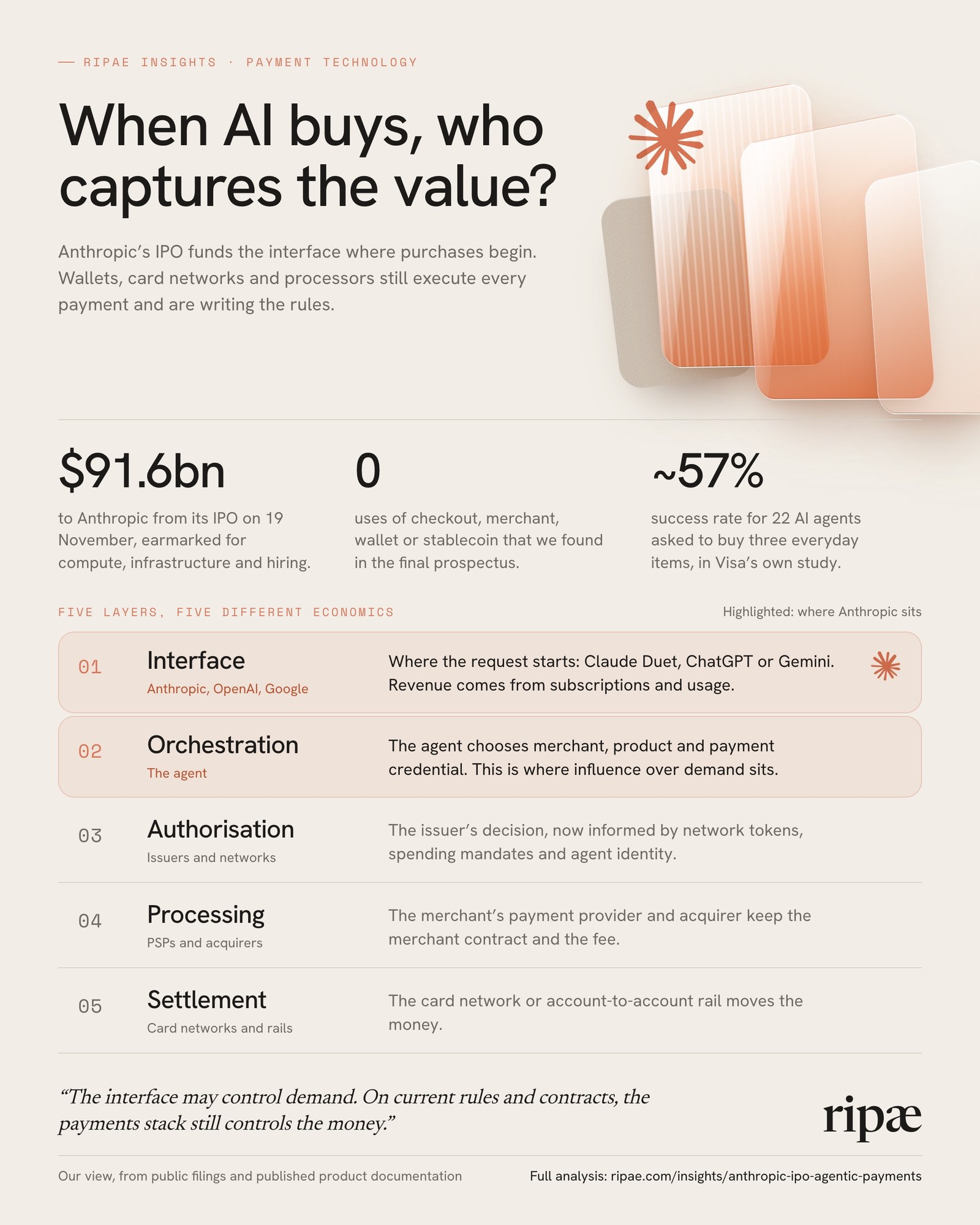
Anthropic raised $91.6 billion in its IPO, none of it aimed at payments. It funds the interface that decides which merchant and wallet an AI agent uses.
In this article

On 19 November 2026, Anthropic began trading on Nasdaq under the ticker ANT. Its closing announcement puts gross proceeds at about $93.5 billion including the underwriters' option, of which about $91.6 billion went to the company; the rest came from shares sold by its co-founders. Alongside the listing, Anthropic sold about $26 billion of non-voting shares in a private placement to Google, NVIDIA, AMD, Broadcom, Micron, Microsoft and TSMC.
For payments, the useful reading is narrower than the headlines. The IPO is first a financing event. The final prospectus says the proceeds will go to general corporate purposes, including compute, infrastructure and hiring, against roughly $900.9 billion of commitments that are substantially all for compute and infrastructure. A search of the document found no use of the words checkout, merchant, wallet or stablecoin.
Our view: the listing does not create agentic payments, and it does not turn Anthropic into a payments company. What it changes is the scale and staying power of a company that increasingly sits where purchases begin. On current evidence, wallets, card networks and processors still execute every payment and are writing the rules. For payments businesses, the question is one of position: whose credential an agent reaches for, who carries the risk when it gets something wrong, and who keeps the relationship with the merchant.
What changed on 19 November, and what did not
Some of what the IPO brought is verified fact. Revenue for the nine months to 30 September was $33.2 billion, up 1,206% on the same period a year earlier, and the prospectus warns that growth at that rate should not be expected to continue. More than 11,900 business customers each generated at least $100,000 of revenue over the trailing twelve months. About 44% of revenue in those nine months came through cloud providers' marketplaces, which act as both distribution and billing channels.
Other widely quoted numbers depend on the basis used. Press reports valued the company at about $1.5 trillion at the $83 offer price. On the 13.37 billion shares the prospectus lists as outstanding after the offering, the figure is closer to $1.1 trillion (our calculation); the higher number appears to include options, restricted stock and convertible notes.
The commerce moves came before the listing. Anthropic published an open-source commerce agent blueprint on 2 September and opened Claude Duet, a proactive agent app that can buy things, to a waitlisted research preview on 21 October. OpenAI had launched Instant Checkout with Stripe in September 2025, and Google published its Agent Payments Protocol the same month. Treating the IPO as the cause of agentic commerce would get the sequence wrong.
What the filing does say about agents is framed as risk. It describes agentic systems "completing transactions with limited human oversight" and warns that exploiting them could lead to unauthorised transactions. It reads as a disclosure about liability.
Anthropic’s actual role in a purchase
Claude Duet is the only Anthropic product we found that pays for anything. It is available by waitlist to US subscribers on Pro, Max and Ultra plans. Anthropic describes it buying things for a user's business through Link, Stripe's wallet: Duet confirms the item, Link asks the user to approve the spend, and Link pays with a virtual card. Anthropic's help page adds the limits: a one-time card scoped to the merchant and amount, a US payment method, no recurring payments, and some sites that block the agent. Duet can also check out with Shopify's Shop Pay. Some actions, such as trading securities or moving money between accounts, are off-limits even with approval.
Stripe's announcement says Anthropic integrated Link's wallet for agents and Stripe's MCP server into Duet, and that Link powers payments for more than 200 personal agents. Anthropic is one client among many. Elsewhere, Claude's browser extension is not permitted to make purchases, and the commerce blueprint for merchants leaves payment to the merchant's existing checkout or an agentic payments provider. On its October earnings call, Visa said it was collaborating with Anthropic to bring those blueprints to its merchant network.
The pattern is consistent. Anthropic orchestrates: it interprets the request, finds the item and asks for approval. Credentials, authorisation, processing and settlement sit with others.
Five layers with five different economics
It helps to separate the layers that "agentic payments" tends to blur together:
- Interface. Where the request starts: Claude Duet, ChatGPT or Gemini. Revenue here comes from subscriptions and usage.
- Orchestration. The agent's choices of merchant, product and payment credential. This is where influence over demand sits.
- Authorisation. The issuer's decision, now informed by network tokens, spending mandates and agent identity. Visa Intelligent Commerce attaches passkey authentication and cardholder-set limits to agent tokens and keeps the instructions as dispute evidence.
- Processing. The merchant's payment provider and acquirer, which keep the merchant contract and the fee.
- Settlement. The card network or account-to-account rail.
Processing economics remain where they were. The open question is the orchestration layer, because an agent that chooses the credential and the merchant can shift volume without touching the processing fee. The card networks have already moved to limit that. Visa's rules for agentic platforms, in the October 2026 edition, require an agent platform to enrol in Visa Intelligent Commerce, obtain consent and verify the cardholder, and not to steer customers to another payment method in a way that denies them a choice. Rule 4.1.23.10 makes the cardholder responsible for actions taken by an agentic payment provider as if the cardholder had initiated the transaction.
The interface may control demand. On current rules and contracts, the payments stack still controls the money.
A worked example
Illustrative scenario, built from published product documentation. It uses no real transaction data. The founder of a small US design studio asks Claude Duet to reorder printer toner from the usual supplier, up to $150.
- Interface and orchestration (Anthropic). Duet finds the item, checks the price, shows exactly what it intends to buy and waits for approval.
- Credential (Stripe's Link). The founder approves the amount in the Link app. Link issues a one-time virtual card limited to that merchant and amount.
- Processing (the supplier's provider). On our reading of the flow, the supplier's existing payment provider receives an online card payment and processes it as usual.
- Authorisation and settlement (issuer and network). The issuer behind the virtual card approves it, and the network settles. Neither Anthropic nor Stripe has published whether Anthropic earns anything from the transaction itself.
- When it goes wrong. If Duet orders the wrong cartridge, the founder can dispute it, but the allocation of non-fraud errors by agents is largely unsettled. The Agentic Commerce Protocol and the AP2 specification both leave disputes out of scope, and Visa's rule puts responsibility on the cardholder where its agentic rules apply.
Three of the five steps belong to payments companies. The step Anthropic owns is the one that decides which supplier and which wallet are used.
Where value could move
This section is Ripae's analysis, not reported fact.
Wallets and credential providers gain the most from early integration. A wallet built into many agents becomes the default credential at the moment of purchase. Link's presence in more than 200 agents shows the race is already on. Visa's anti-steering rule limits how hard an agent platform can push one credential, but defaults still matter.
Incumbent rails are being strengthened, not bypassed. Network tokens, mandates and agent identity are being added to the existing card rails. Stripe's Shared Payment Tokens let an agent grant a seller a token limited by amount, currency and expiry, which the agent can revoke, and Stripe says they support Visa's and Mastercard's agentic programmes as well as Affirm and Klarna. Agent platforms are plugging into incumbent infrastructure rather than replacing it.
Integration will commoditise; trust will not. Stripe, PayPal, Square and Adyen all publish Model Context Protocol servers that let agents call their APIs. Connecting an agent to a payment API is becoming a standard feature. Scoped credentials, consent records, risk scores for agent traffic and dispute evidence are harder to copy, and that is where pricing power is likely to hold. Mastercard is testing a score that estimates how likely a transaction is to be agent-initiated, a sign of where the networks see value.
Merchants face the real distribution risk. An agent that chooses suppliers can weaken a merchant's direct relationship with its customer, regardless of how the payment is processed. Our analysis of why most AI agents never leave the pilot applies on the merchant side too: control of data and of the decision is what gets negotiated.
Delegated authority is the security problem that matters. An agent acting on a scoped mandate is, in effect, signing on the customer's behalf. Our analysis of the Binance exploit showed how much damage follows when the authority to sign is not tightly controlled. The same discipline applies to agent mandates.
The case against
The strongest counterargument is that none of this is yet material. Visa's chief executive described the number of agentic transactions on the network as "albeit limited" in October, while reporting nearly 50 AI partners live and in production. Visa publishes partner counts rather than volumes, and we found no network or protocol that publishes agentic transaction volumes.
Agents are also unreliable shoppers. In a study Visa ran itself, reported by Fortune, 22 agents were asked to buy three everyday items, and the overall success rate was only around 57%. Adobe reported AI-referred traffic to US retail sites up 393% year on year in the first quarter of 2026, but those are clicks from AI tools, not purchases completed by agents. Forecasts such as Bain's $300 billion to $500 billion of US agentic commerce by 2030 include purchases agents merely influence, and they use definitions that are not comparable across firms.
Finally, the capital points elsewhere. Anthropic's spending commitments are for compute, and 44% of its revenue arrives through cloud marketplaces serving enterprise customers. The listing may pull the company further towards enterprise work, leaving consumer commerce a sideshow. Our view would weaken if agent transaction volumes stay negligible through 2027. It would also need revising if Anthropic launched its own stored credentials or began charging a fee on transactions.
What it means in the GCC
The UAE has moved early. Mastercard's first Agent Pay transaction outside the US was a pilot with Majid Al Futtaim on 18 November 2025, and Visa and Aldar completed the region's first live Visa Intelligent Commerce transaction in December. In May 2026, Visa's Agentic Ready programme opened in the UAE with issuers, an exchange house, a buy-now-pay-later provider and digital fintechs, giving them a production-grade environment to test agent-initiated transactions. Our earlier piece on agentic payments in the UAE covers these programmes in detail.
The global interfaces have not yet arrived. Duet's purchasing requires a US payment method, so GCC cardholders cannot use it today. That gives regional institutions time to set the terms on which agents connect.
The frameworks are already in place. The CBUAE's Open Finance Regulation lets a customer consent to service initiation for a single payment or for recurring payments within set parameters for up to 12 months. That structure maps closely onto an agent mandate, although applying it to agents is our inference. The CBUAE's Payment Token Services Regulation lets merchants accept licensed dirham payment tokens and limits foreign payment tokens to buying virtual assets. On our reading, agent stablecoin payments to merchants onshore would therefore run on licensed dirham tokens; the financial free zones have their own regimes. Aani, the UAE's instant payment platform, already offers request-to-pay and proxy payments that an agent could, in principle, use. In Saudi Arabia, the SAMA governor said in September that open banking had moved from the sandbox to commercial licensing and described finance entering an era powered by AI agents.
For GCC payments businesses, the lasting advantages are local: acquiring relationships, local payment methods, and consent infrastructure that regulators already recognise. Our payment technology practice and open banking practice work on exactly these layers.
What payments businesses should do now
- PSPs and acquirers: make agent traffic recognisable. Accept network agent tokens, verify agent identity, and price the risk of agent traffic before treating it as ordinary online volume.
- Issuers: offer agent-level spending limits, merchant scopes and instant revocation in the app, and write a dispute policy for agent errors before the first complaint.
- Wallets and fintechs: integrate early with agent platforms, and treat consent records and mandate logs as product features.
- GCC institutions: map existing open finance consent to agent mandates, and make sure local methods such as mada, Jaywan and Aani can be selected by an agent.
Signals to watch over the next 12 to 24 months
- Whether Anthropic reports any commerce or transaction metric in its quarterly filings.
- Claude Duet leaving research preview, and accepting payment methods outside the US.
- Card networks publishing agentic transaction volumes rather than partner counts.
- Dispute and chargeback rates for agent-initiated transactions, and any rule that allocates liability for non-fraud agent errors.
- How many wallets agent platforms offer at checkout, and whether any platform takes a fee on the transaction.
- Regulatory guidance on agent-initiated payments from the CBUAE, SAMA or other central banks.
- The first GCC acquirers or PSPs certifying agent traffic with local payment methods.
The bottom line
Anthropic's IPO funds the interface layer of agentic commerce on a scale few companies can match. It does not move payment execution, and on current evidence it has not caused the shift. Agents are starting to decide where purchases go, while wallets, networks and processors still decide how they are paid for, who is liable and what it costs. Payments businesses that make themselves the trusted, low-friction choice inside those agents will gain from the spending, whichever interface wins.
- Anthropic announces closing of initial public offering, including full exercise of underwriters’ option to purchase additional shares, and closing of concurrent private placement — Anthropic, 20 November 2026
- Anthropic, PBC - 424(b)(4) (final prospectus) — U.S. Securities and Exchange Commission, 19 November 2026
- Introducing Claude Duet — Anthropic, 21 October 2026
- How to use Link by Stripe with Claude Duet — Claude Help Center
- Stripe and Anthropic help entrepreneurs run their business inside Claude Duet — Stripe
- Building commerce agents with Claude — Anthropic, 2 September 2026
- Claude in Chrome permissions guide — Claude Help Center
- Visa Inc. Q4 2026 earnings call, corrected transcript — Visa, 27 October 2026
- Visa Core Rules and Visa Product and Service Rules, section 4.1.23 — Visa, October 2026 edition
- Visa Intelligent Commerce concepts — Visa Developer Center
- Shared payment tokens — Stripe Documentation
- agentic-commerce-protocol (specification repository) — OpenAI and Stripe, GitHub
- Agent Payments Protocol (AP2) documentation — AP2 project
- Buy it in ChatGPT: Instant Checkout and the Agentic Commerce Protocol — OpenAI, 29 September 2025
- Mastercard advances agentic commerce with new trust and intelligence services — Mastercard, 30 September 2026
- Mastercard brings agentic payments to life with Majid Al Futtaim in the UAE with Agent Pay debut — Mastercard and Majid Al Futtaim, 18 November 2025
- Visa partners with Aldar to complete first end-to-end voice-enabled agentic payment in the region — Visa, 18 December 2025
- Visa launches “Agentic Ready” program in UAE to accelerate agent-led commerce — Visa, 20 May 2026
- AI traffic grows but retail sites lag in AI search visibility — Adobe, 16 April 2026
- Visa tested AI shopping agents, and they failed nearly 50% of the time — Fortune, 5 November 2026
- 2030 forecast: how agentic AI will reshape US retail — Bain & Company, 17 December 2025
- Open Finance Regulation (C 03/2025) — Central Bank of the UAE, 10 July 2025
- Payment Token Services Regulation (C 2/2024) — Central Bank of the UAE, 2024
- Keynote speech, Money20/20 Middle East (Governor of the Saudi Central Bank) — BIS / Saudi Central Bank, 15 September 2026
- Al Etihad Payments: Aani — Al Etihad Payments
- Supporting additional payment methods for agentic commerce — Stripe, 3 March 2026
- Model Context Protocol (MCP) — Stripe Documentation
- MCP server quickstart guide — PayPal Developer
- Square Model Context Protocol Server — Square Developer
- Adyen Model Context Protocol (MCP) server — Adyen Docs
Ripae helps regulated financial institutions and fintechs design, build and modernise payment systems, from real-time rails and wallets to cross-border flows.